Garage Door Opener for a Heavy or Tall Door
Choose a garage door opener for a heavy door by matching its weight, dimensions, track and spring system to the opener’s requirements. Have balance problems repaired first, then choose between a compatible wall mount model and a belt drive with the features you need.
On this page (9 sections)
- What should you check before choosing a garage door opener for a heavy door?
- Is a wall mount opener right for a tall or low-headroom door?
- When is a belt drive a better choice?
- How do you compare these opener types?
- What should you plan before installation?
- Which access features matter for a heavy door?
- How do you care for an opener on a heavy door?
- What mistakes should you avoid with a heavy garage door?
- Which garage door opener should you choose for your heavy door?
Choose a garage door opener for a heavy door by matching the door’s weight, dimensions, track and spring system to the opener’s requirements. A larger motor label cannot make up for an unbalanced door or an incompatible installation.
For a tall door, check height and total area together. For limited ceiling space, check wall mount compatibility before assuming that removing the overhead rail solves the problem.
For a broader overview of drive types and lift capacity, see our garage door openers explained guide.
What should you check before choosing a garage door opener for a heavy door?
Check door condition and compatibility before motor power. A heavy door needs working counterbalance springs and an opener approved for its full setup.
The springs carry much of the door’s weight during normal travel. The opener moves that balanced system, so a door that suddenly feels much heavier may need repair rather than a stronger motor.
Stop powered use if the door rises unevenly, leaves a cable loose or makes the opener strain. Have a qualified garage door technician inspect it, and do not adjust springs, cables or their mounting hardware yourself.
Do not release an open door from its opener if you suspect a spring or balance problem. Without proper support, the door could fall.
Measure the heavy door before choosing an opener
Record width, height and door construction, then find its weight through the door manufacturer or installer. Do not estimate weight from appearance or try to weigh the door yourself.
A solid wood door, an insulated steel door and a door with large glass sections can place different demands on the system. Adding insulation or other hardware can also change the balance of an existing door.
Use this checklist when speaking with an installer:
- Door width and height, measured across the door itself.
- Door weight or enough identifying information to confirm it.
- Sectional or one-piece construction.
- Spring type and position.
- Standard, high lift, vertical lift or low headroom track.
- Available space beside the torsion shaft and above the door.
- Outlet location and the door’s usual daily use.
If you are unsure how much capacity to look for, use our guide to what size garage door opener you need as a starting point. Bring the measurements and hardware details when confirming fit.
Is a wall mount opener right for a tall or low-headroom door?
A wall mount opener suits a garage where freeing ceiling space matters and the door hardware supports it. Low headroom alone does not make this the right choice.
These openers sit beside the door and turn its torsion shaft instead of pulling a trolley along an overhead rail. The door still needs clearance throughout its travel, so freed ceiling space is not automatically usable storage space.
A garage with high lift track may benefit from that layout, especially if an overhead rail would cross space you want to keep clear. Measure around the shaft, nearby walls, shelves and pipes before choosing a unit.
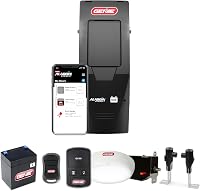
Genie B6172H: for compatible tall and high lift doors
The Genie B6172H is the clearest starting point here for a buyer who needs stated height, weight and area limits. It supports compatible standard, high lift and vertical lift residential doors up to 14 ft high, 850 lb and 180 sq ft.
It includes battery backup, Aladdin Connect smart control, a wireless wall console, a wireless LED light and an automatic door lock. Its Safe-T-Pulse system checks electronically for slack in the cables before closing.
Choose it when your installer confirms the door fits and you want those access features in a wall mount setup. Aladdin Connect supports Alexa, Google Assistant and SmartThings, which may help if you already use one of those platforms.
Skip it for extension springs, one-piece doors, reverse wound springs or low headroom outside hook-up. It also requires a standard outlet within 6 ft of the opener, so include electrical access in the installation plan.
LiftMaster 98022: for clearing the ceiling over parked cars
The LiftMaster 98022 suits a buyer whose main goal is removing the overhead opener rail from a compatible garage. LiftMaster describes its wall mount design as reducing sound and vibration through the ceiling.
It includes myQ Wi-Fi connectivity and Security 2.0. That makes it worth considering if you want phone control while moving the motor off the ceiling.
Choose it only after confirming the door’s capacity requirements and mounting clearances. The available details do not guarantee a door weight or height limit, so do not assume it matches the Genie’s operating range.
Skip it for roll up doors, low headroom track or Wayne Dalton Torquemaster systems. Its required front mount torsion bar arrangement is a firm fit requirement.
Compare the layouts in our jackshaft vs belt drive guide. For more on the wall mount format itself, read what a jackshaft garage door opener is.
Can a wall mount garage door opener handle a heavy 12 foot door?
A compatible 12 ft door can fit the Genie’s operating range, but width can rule it out even when height fits. Calculate door area by multiplying width by height.
A door measuring 12 ft tall by 18 ft wide covers 216 sq ft, exceeding its area limit. A narrower door may pass that check but still need weight, track and spring approval.
Treat each limit as a separate requirement. Never combine the maximum width from one configuration with the maximum height from another without checking the full installation requirements.
Does low headroom mean you need a wall mount opener?
No, low headroom requires a hardware check, not an automatic switch to wall mount. The exclusions above can rule out these models even when ceiling space is tight.
Ask the installer to identify the exact track and spring arrangement. If changes are needed, compare the complete work involved with fitting an approved rail opener.
When is a belt drive a better choice?
A belt drive is a practical choice when a ceiling rail fits and you want quiet operation near living space. Chamberlain describes both models here as quiet, using reinforced belts and DC motors.
Check the full rail path, including its ceiling supports and clearance above the moving door. A tall door also needs a rail arrangement approved for that height; do not assume the standard package reaches.
Chamberlain 1-1/4 HP: for frequent use and demanding conditions
Choose the Chamberlain 1-1/4 HP model if you want a belt drive and Chamberlain confirms it suits your door and use pattern. The brand positions this model for standard doors, frequent use and demanding conditions.
It also includes Corner-to-Corner Lighting. That feature may matter if you want the opener to help light a wider garage rather than relying only on a separate ceiling fixture.
Skip it if your door’s approved weight, height or rail requirements remain uncertain. A stronger-sounding motor label is not enough evidence for an unusually heavy wood door or a custom oversized door.
Chamberlain 1 HP: for daily use with camera access
Choose the Chamberlain 1 HP model if your door is approved for it and you want phone control, video monitoring and outage access in a belt drive setup. Chamberlain describes this model for frequent use.
It includes single LED lighting and 2 remotes. If the stronger model’s lighting arrangement is not useful to you, this is the alternative to compare after confirming fit.
Skip it if you need a wall mount layout or cannot confirm the door’s installation requirements. Its smart features do not change which doors it can safely operate.
What do the Chamberlain horsepower labels mean?
The 1 HP and 1-1/4 HP labels are AC motor lift-capacity comparisons. Chamberlain explains that DC motor lifting capacity is typically not measured in horsepower.
Use those labels to understand the models’ positioning, then confirm approved door limits. They do not provide a pounds-based comparison or prove that either model supports a larger door than the other.
Both Chamberlain models carry a 10-year motor and belt warranty. Check the warranty terms when comparing installation choices, especially if work on the door or rail is also needed.
Our heavy door opener roundup compares more options for this use.
How do you compare these opener types?
Choose by installation fit first, then the features that solve a daily problem. This comparison shows the buyer each model suits after compatibility is confirmed.
| Opener | Strongest reason to consider it | Who should look elsewhere |
|---|---|---|
| LiftMaster 98022 Premium Series jackshaft opener | Clearing ceiling space with myQ control | Buyers with excluded track or spring systems |
| Chamberlain 1-1/4 HP belt drive opener with camera | Frequent use, video access and broader garage lighting | Buyers who need a wall mount layout |
| Chamberlain 1 HP belt drive opener with camera | Daily belt drive use with camera access and single LED lighting | Buyers whose tall or heavy door lacks fit approval |
| Genie B6172H wall mount opener | Compatible tall or high lift doors with stated capacity limits | Buyers with excluded springs, door construction or track arrangements |
For a bedroom above the garage, consider the full door system as well as the motor. Worn rollers, loose hardware and vibration through mounting points can remain noisy after an opener replacement.
If your ceiling has room for a rail, compare the layouts in our belt drive vs chain drive guide. The drive type should follow your door requirements and noise priorities.
What should you plan before installation?
Plan mounting, power, rail reach and safety checks before removing the old opener. An existing motor’s location does not prove that a replacement can use the same supports or accessories.
For a belt drive, confirm the approved rail length and mounting method. Do not reuse the old rail, sensors or controls unless the new opener’s instructions explicitly allow it.
For wall mount installation, confirm shaft access and all required clearances. Shelving that leaves room for the motor may still block service access or interfere with another required component.
Ask the installer to identify how any manual door lock must be handled. A locked door can make an opener strain, and an included automatic lock must be fitted according to its own instructions.
Before regular use, follow the manual’s procedure for setting travel and force, checking photoelectric sensors and checking contact reversal. Increasing force is not a repair for binding, poor balance or an obstruction.
Keep the opening clear during these checks and learn the emergency release procedure while the system is working normally. If the garage has no other entrance, discuss emergency access before installation.
Which access features matter for a heavy door?
Battery backup matters most when power loss would disrupt access. Phone controls and cameras serve different needs, so compare them separately.
The Genie and both Chamberlain models include backup. Do not assume the LiftMaster package includes it based on the battery information alone; confirm the exact package if outage operation is essential.
Backup does not keep a damaged or unbalanced door usable, and its battery needs care under the manual’s schedule. It also does not guarantee that your home network stays online during an outage.
Our guide to whether you need garage door opener battery backup can help you judge its value for your garage.
For smart control, check Wi-Fi coverage at the actual motor location before installation. A good signal inside the house may not reach reliably through the garage wall.
Set a camera’s angle around the area you need to see, then check its view with the door both open and closed. Read the current app terms for any video features you plan to use rather than assuming every feature is included indefinitely.
How do you care for an opener on a heavy door?
Keep the door moving freely and the safety system working. The motor should not have to overcome faults that develop in the tracks, rollers or counterbalance system.
Watch for changes in sound, speed and alignment during normal use. A new scrape, shudder or uneven movement deserves attention before it becomes a repeated strain on the opener.
Keep the tracks clear and wipe dirt from the safety sensor lenses. Lubricate only the parts identified in the door and opener manuals; do not apply grease to the belt or coat the tracks indiscriminately.
Follow the manual’s schedule for battery care and safety checks. Arrange professional service for damaged rollers, frayed cables, spring problems or movement that becomes rough.
During freezing weather, check that the bottom seal is not stuck to the floor before opening. Stop if the motor strains rather than repeatedly commanding the door to move.
What mistakes should you avoid with a heavy garage door?
Avoid buying power before confirming fit. Most poor choices in this category come from overlooking the door system or confusing convenience features with lifting approval.
- Replacing the motor before repairing the door: a new opener cannot correct failed springs or binding hardware.
- Checking height but ignoring area: a wide, tall door can exceed a limit even when its height fits.
- Assuming every wall mount model fits low headroom: track and spring exclusions still apply.
- Treating horsepower as a weight limit: ask for approval for the actual door.
- Keeping old components without approval: rails, controls and sensors need confirmed compatibility.
- Raising force to stop reversal: find the cause and follow the manual instead.
Get an installation plan that covers the door, opener, power access and any required hardware changes. That gives you a useful comparison between proposals instead of comparing motor names alone.
Which garage door opener should you choose for your heavy door?
Choose your garage door opener for a heavy door by eliminating incompatible models first. Then let ceiling space, lighting, outage access and phone control decide between the remaining options.
Pick the Genie B6172H when you need a wall mount option for a compatible tall or high lift door and its stated limits cover your measurements. Pick the LiftMaster 98022 when clearing the ceiling is the priority and its required torsion setup fits.
Choose the Chamberlain 1-1/4 HP for an approved belt drive installation where its demanding-use positioning and lighting suit your garage. Choose the Chamberlain 1 HP when the door fits and its daily-use features cover your needs.
If weight, balance or track type is still unknown, resolve that before ordering. Use our guide to choosing a garage door opener to turn those confirmed details into a final shortlist.
Frequently asked questions
What garage door opener is best for a heavy door?
Choose an opener approved for your door’s weight, dimensions, track and spring system. The Genie B6172H is an option for compatible tall or heavy doors within its stated limits, while the other models require their own fit checks.
Have balance problems repaired before comparing motors or smart features.
Can a wall mount opener lift a 12 foot garage door?
The Genie B6172H can suit a compatible 12 ft door within its 850 lb weight limit and 180 sq ft area limit. Height alone does not guarantee fit.
Check width, spring arrangement, track type, mounting clearance and power access before choosing it for a tall garage door.
Will a jackshaft opener work with low headroom track?
Do not assume a jackshaft opener fits low headroom track. The LiftMaster 98022 excludes low headroom track, and the Genie B6172H excludes low headroom outside hook-up.
Have a qualified installer identify your hardware and confirm an approved opener or track arrangement before you order.
Should I replace the opener if a garage door feels heavy?
Have a qualified garage door technician inspect the door first. A door that suddenly feels heavy, moves unevenly or will not stay balanced may need spring or hardware repairs rather than a new motor.
Stop powered use if it struggles, and do not adjust springs or cables yourself.
Does a stronger opener make an unbalanced door safe?
No, a stronger opener cannot make an unbalanced door safe. The springs must counterbalance the door so the opener can move it without fighting its full weight.
Have the fault repaired, then choose an opener approved for the door and complete the safety checks in its manual.